Making Neat and Compact Thread Heads
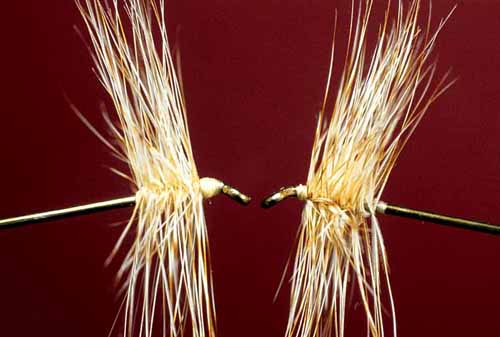 Two thread heads, one large, one small,
both neat and sound.
Thread-head size is mostly a matter of style.
Though simple in construction and function, thread heads are, to many tiers, a plague.
But a bit of understanding and strategy can make them manageable—
even make them pleasant to tie...
...and the result is a head that is neat, sound.
You'll see.
Here's how to tie a good thread head:
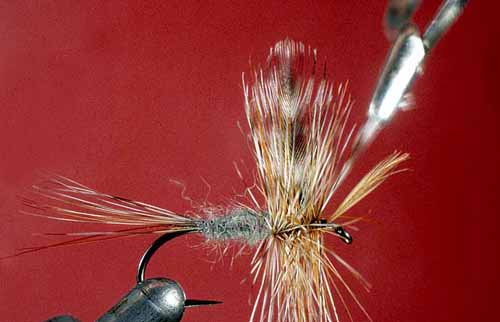 Step 1
1. The first rule for easily creating good heads on flies is:
leave space for the head on the hook's shank. Many tiers run the fly right up to the hook's eye, and the head that results is sloppy and unsure.
Note that on the fly shown here there is just a bit of bare shank behind the eye, as there should be.
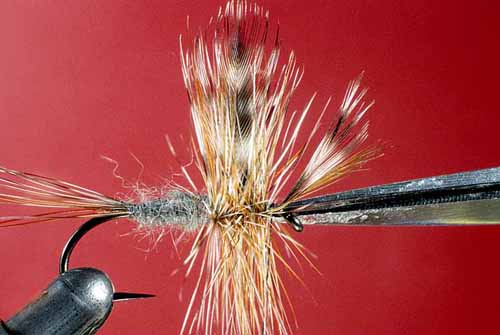 Step 2
2. The second rule is: spend the extra second or two required to closely trim the last materials, the ones near the hook's eye.
Many tiers trim these materials quickly and roughly. Forming a head over the bulky mess that remains takes too much thread, too much time,
and results in a head too sorry to show one's friends.
Take the time to trim well, and you'll not need to hide your work.
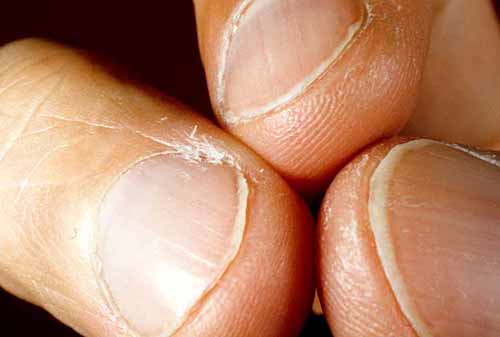 Step 3
3. The third rule: draw everything back from the hook's eye, to allow clear access for creating the head.
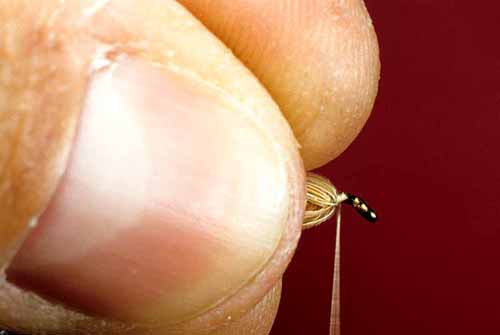
To do this, I use what I call the "triangle," a tiny triangular space formed within the tips of the thumb, first, and second fingers.
 Step 4
4. Slip the triangle over the hook's eye and back. Hold the thread taut as you let the triangle slip past it.
Now all the materials should be held firmly back from the eye.
With clear access for building the head—and plenty of shank to build it on—
all should go well.
 Step 5
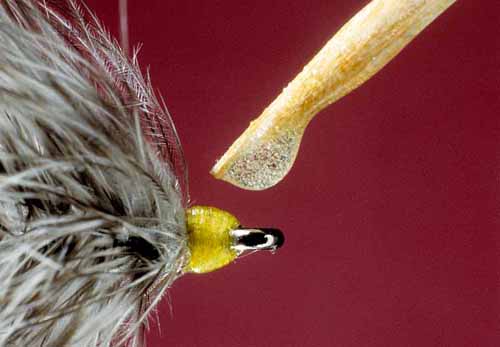
5. Add head cement to the head, just enough to saturate the thread and no more—excess head cement flows back into the materials,
darkening them and freezing them rigid. I use epoxy glue(not epoxy finish), which I dot on with a bodkin (or a toothpick, as shown here, for larger heads),
then spread into a thin layer over the head.
Whatever you used, keep it out of the hook's eye, and run a fine feather through the eye
after a few minutes as insurance.
And now you know how to tie a neat and compact thread head.



Click here to hear Skip's interviews on popular podcasts...

Click here to hear Carol's interview on AskAboutFlyFishing.com...
Click here to hear Carol's interview with Christian Bacasa on the Fly Fishing Insider Podcast...
*Announcements*
 ©Carol Ann Morris
Click here: Read Skip's essay from Big Sky Journal, Montana Hoppers: The Princess and the Brute...
Skip's latest books:
New Fly Fishing Essay Book Release, July 2026:
Imposters: The Flies We Fish and the Fish They Catch is on Amazon...

Click here: Imposters...
Morris & Chan on Fly Fishing Trout Lakes is on Amazon as an e-book...
 Morris & Chan on Fly Fishing Trout Lakes
Click here: Morris & Chan on Fly Fishing Trout Lakes e-book...
Top 12 Dry Flies for Trout Streams: How, When, and Where to Fish Them, is on Amazon as an e-book...Click on the links below...
 Top 12 Dry Flies for Trout Streams: How, When, and Where to Fish Them
Click here for more: Top 12 Dry Flies for Trout Streams: How, When, and Where to Fish Them...
Top 12 Nymphs for Trout Streams: How, When, and Where to Fish Them, 2nd Edition, is an e-book and a paperback.
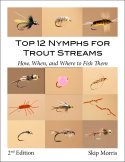 Top 12 Nymphs for Trout Streams: How, When, and Where to Fish Them (2nd Edition)
Click here for more info: Top 12 Nymphs for Trout Streams: How, When, and Where to Fish Them (2nd Edition)
Click here for more info: Skip's e-book of fly fishing essays (chronicling 50 years of adventure on the water)
500 Trout Streams...
500 Trout Streams...
 365 Fly Fishing Tips for Trout, Bass, and Panfish
Click here to get more info:
365 Tips for Trout, Bass, and Panfish...
365 Tips for Trout, Bass, and Panfish...
Print Skip's chart for FREE:
Skip Morris's Trout-Fly Proportion Chart
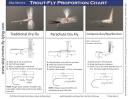
Go to Skip Morris's Trout Fly Proportion Chart
Skip's Predator is available to buy...
Skip's ultra-popular Predator—a hit fly for bluegills, other panfishes, largemouth bass, smallmouth bass, and trout—is being tied commercially.
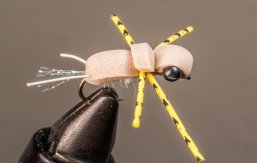
The Predator
CLICK HERE to learn more about the Predator...
Learn to Tie Skip's Predator
Do you want to tie the Predator?
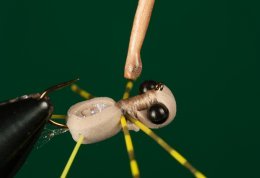
Tying the Predator
Skip shows you how to tie it on his YouTube Channel link, listed below:
CLICK HERE to see Skip's detailed video on how to tie the Predator...